Showing posts with label conferences. Show all posts

Tuesday, December 31, 2013

Wrapping Up 2013

This year I'm spending New Year's Eve in Montreal, Canada.  Since it's around -20C, I'm having a quiet night in and reflecting on the past year.  I already posted about the reading I did this year, but since posting a year-end summary has become a bit of a tradition for me I'll continue that in this post.

Travel
This is probably the first year I traveled more for work than I did for holidays, but the holidays were longer so it balanced out.  Here's where the year took me:
  • UIUC, Urbana Champagne Illinois: March 2013
  • Victoria: Memorial Day Weekend, 2013
  • Ft Lauderdale, Florida: August 2013
  • Purdue University, West Lafayette Indiana: Sept 10-12 2013
  • Minneapolis: October 1-6 2013
  • Vancouver: October 11-13 2013
  • Iceland, France, and Monaco: Oct 17-Nov 1 2013
  • Cobourg, Toronto, Barrie, and Montreal: Dec 25 2013 - Jan 2 2014
I wanted to go to Europe and back to Japan in 2013 but only made it to Europe.  For 2014 I'm really hoping to get back to Japan again, maybe even for New Year's!  But I'll be starting 2014 with a quick trip to Las Vegas.

Professional Life
This year was even busier than the last, and involved a switch of teams, so there was lots to do.  Here are some of the highlights:
  • Attended this year's Grace Hopper Conference and worked on attendee engagement for my company
  • Presented as part of a panel on mobile vs. web app development, an industry experience panel, and a Student Opportunity Lab on Careers in Test at GHC13
  • Went on two College Campus Interview trips
  • Had a highschool student job-shadow me for a day
  • We shipped GDR3 for Windows Phone 8!
Blog
I've had bursts of activity on my blog with some droughts in between.  I try my best but it gets hard between my busy work and travel schedule as well as my hobbies and fitness schedule!  Here are the top five posts from my blog in 2013:
Other
Outside of work and travel, I've continued playing Frisbee and climbing.  This year I tried out captaining for the first time, which was super fun!  I'm getting better at bouldering too and did my first V3-level routes this year.  I'm hoping to get some skiing in this spring.

At Musee d'Orsay in Paris, France this October

Friday, March 15, 2013

Grace Hopper 2013 Proposals

This year I'm part of three panel proposals for GHC13.  GHC submission time always brings out the Women in Tech community, and this year was no different.  I joined the first proposal via a large email thread I got added to by a colleague and found it contained people from many great companies doing lots of interesting work!  For the second two proposals I put out requests on the Systers community, Twitter, and this blog for contributors and was overwhelmed with the response.

Here are the abstracts for our proposals.  Good luck to everyone else who submitted!

Native or Web, Which App Should I Build? A Mobile Developer’s Dilemma
Chaitrali Amrutkar, Georgia Institute of Technology
Tracy Chou, Pinterest
Sara Haider, Twitter
Kate Tsoukalas, Microsoft
Jane Wang, Etsy

The difference between the capabilities of web-based and native mobile apps is increasingly being blurred. While building an app for mobile users, developers need to make several considerations such as platform specificity, speed, user experience and commercial opportunities. This panel will discuss design principles, best practices, tools, security considerations and trade-offs in development of native and web apps on mobile devices. Our panel consists of experts from academia and industry.

Thinking Big about Careers in Test: Driving Your Career in Forward
Kery Laughter, Space Dynamics Laboratory
Kate Tsoukalas, Microsoft
Mirkeya Capellan, Sogeti USA / Pace University
Kavita Maheshwari, Trilixx.com
Iccha Sethi, Rackspace

Although the role of software testing in ensuring software quality is well established, the concept of a Test Engineer is relatively novel. There is an increased need for Engineers who can fill this role, but most institutions do not formally teach Test skills and many tech workers still do not clearly understand Testing. In this panel we explain technical specifics of Test skills, role, and directions for Test careers.

Thinking big about great mobile experiences: Smart development and test techniques drive us forward!
Rosario Robinson, Anita Borg Institute
Kate Tsoukalas, Microsoft
Leanne Waldal, OTIVO
Jennifer Wong, Wyley Interactive
Foghor Tashi, Nigerian Breweries Plc

As the number of mobile technology user is increasing, developers need to switch their thinking from designing applications for a desktop environment to cater to the specific needs, limits, and opportunities of mobile devices. However, many developers of mobile websites and applications repeat common mistakes that result in a poor user experience. This panel aims to raise awareness of these pitfalls and provide developers with strategies to overcome them.

Wednesday, March 13, 2013

GHC13 Panelists Needed for Mobile Tech Panel


Yesterday I wrote about a proposal I'm working on for GHC13.  Luckily I got a great response from my post and found more than enough panelists.  

However, I have a second proposal entitled "Thinking big about great mobile experiences: smart development and test techniques drive us forward!".  Here's the abstract:

"As the number of mobile technology user is increasing, developers need to switch their thinking from designing applications for a desktop environment to cater to the specific needs, limits, and opportunities of mobile devices. However, many developers of mobile websites and applications repeat common mistakes that result in a poor user experience. In this talk, we will:
  • Share important guidelines for developing better mobile applications and websites such as: planning principles, design modeling principles, coding principles and concepts and others.
  • Analyze and present common pitfalls, bugs, and design flaws made by mobile developers
  • Present strategies and techniques for testing mobile-focused products
  • Provide a forum for members of the audience to share their mobile testing/developer experience"
Right now we have two panelists and are looking for up to two more panelists and one moderator.

Please let me know if you are interested!

Tuesday, March 12, 2013

GHC13 Panelists Needed for Testing Proposal


I have a proposal for a panel for GHC13: "Developing Your Career in Test".  Our idea is to give real-world examples of testing techniques via demos and also to give advice on career development.  Right now we have two panelists and are looking to add:

- a moderator
- a Tester from another company (we are from Microsoft and Pace University)
- [optional] a panelist who tests as part of their role but whose title is not necessarily Test/QA

Please let me know if you are interested, time is getting short!

Friday, May 18, 2012

GHC 2012 Submission Results

The results are in for two of the proposals I submitted to this year's Grace Hopper Conference (GHC12).  I'm happy to say that although the acceptance rate was especially low this year, so far one of my proposals has been accepted!

The proposal is a Birds of a Feather session with my two good friends Kerry Corrigall and Aakriti Agarwal and is titled "Are we ready for the next level yet? Perspectives from junior women in technology".  It's all about our experiences making our way through our respective companies as junior women and our thoughts on what junior women can do to make it to the mid-career stage.  

I went to school with Kerry, who is now working in the IT industry, and did a BOF on Women in Tech student groups at GHC 08 with Aakriti.  Interestingly, Aakriti lives in Singapore, Kerry lives in Canada, and I live in the US, making our panel truly international.  I am so excited to be presenting with them this fall!

Friday, January 13, 2012

A Few CES-Related Items...

Are you following the latest tech coming out of CES this year?  I was going to post about some of the cool new tech being shown there, but I found two interesting videos related to CES and Women in Tech that I wanted to share instead (even though the new Nokia 900 with Windows Phone is pretty exciting!)...

First up is a piece by the BBC which explores the effect CES' 'Booth Babes' has on attendees of both genders.  It's interesting to hear the perspective of women working in tech at CES - I thought they did a great job of expressing their discomfort in a way that (hopefully) all viewers of the video can relate to.

Second there is a video of a panel on Women in Tech with panelists Padmasree Warrior of Cisco, Marissa Mayer of Google, Caterina Fake of Hunch, and Lindsey Turrentine of CNET.  Their conversation is interesting and ranges across many aspects of the issue, from when to start educating students on CS, work-life balance, and how to succeed in the tech industry.

What are your thoughts on CES?  I'd be interested to hear from anyone who has actually been there in person!

Wednesday, November 30, 2011

Dr. Shirley Ann Jackson GHC Keynote

A while back I posted about Dr. Jackson's GHC keynote speech.  I'm sure my notes didn't do it justice, but luckily the video has finally been posted so I can share it with you!  Enjoy, it's well worth watching.

Monday, November 14, 2011

Looking Forward to GHC12

Like many people, I came back from GHC11 supercharged and excited to get back to work!  GHC is energizing, motivating, and inspirational.  So naturally, I'm already thinking about next year's GHC, which will be in Baltimore, and topics for possible talks, panels, or BOFs.  The theme next year is, "Are we there yet?"; here's a few ideas kick off the brainstorming:

  1. Are we mentoring new grad women well enough yet?  I think the transition from academia to industry is hard, and especially if you've gone from a place with a great support network for women in tech to one where that support network is minimal, it can be even harder.  What are we doing to help make this transition easier for female new grad hires? 
  2. Related to 1: How to figure out what you need to know that you don't know as a new grad hire - what to ask for, what strategies to move your career forward, how to manage up.
  3. Mobile web development, testing techniques, and/or something web app-related.  Maybe looking at how different companies' techniques differ?
What topics are you interested in seeing next year?  If you're interested in presenting, what topics would you like to present?  I'm also curious to know which presentations you thought were the best this year. 

Saturday, November 12, 2011

GHC11 Day 3 Recap

I mentioned that days at GHC are long - mine went from 8am yesterday til well after midnight!  Here's a summary of the events of the day:
Ming Hua giving her talk.
  • Keynote by the Honourable Shirley Ann Jackson, PhD: read my summary here.
  • Facebook technical talk (Large Scale Computing track), "Understanding Relationships through Data": This talk was presented by my grad school labmate, Ming Hua.  Read my summary here.
  • Kinect Lounge: This was a really cool initiative by Microsoft.  They set up a 'Kinect Lounge' in the exhibition hall, where anyone could drop by and play Dance Central.  It was great to see so many people come out and try Kinect, many for the first time!  It was also nice to hear the 'oohs' and 'ahs' when they used the voice control feature.  I also met another Kate who works at Microsoft and is Canadian there, which was an unusual coincidence.  We had a great conversation! :-)
  • Systers Luncheon: If you are a technical women and not on the Systers mail list, you should be!  I get so much value almost every day from the questions and insights posted here, and it was so nice to meet some fellow Systers in person!
  • Plenary Session: In the afternoon there was a great panel discussion with sponsors and their sponsored colleagues.  Sponsorship is a new concept for me so it was helpful to hear about the difference between sponsorship and mentorship and how to negotiate the nuances of the sponsor relationship.
  • Industry track talk on "Understanding your Customer": read my summary here.
  • Sponsor Night: Sponsor Night is a GHC tradition where the conference's platinum sponsors (this year Google and Microsoft) host an evening of food, t-shirt giveaways, music and dancing!  It's a great way to unwind after the packed conference schedule.  Anita Borg loved dancing, so this is a nice way to honour her.  I think the food at the dinner was the best food I had at the conference all week!  So delicious!
A bit dark, but here's what ~3000 technical women dancing looks like!

Friday, November 11, 2011

No Customers, no Business: What if you could delight your customers?

This session started off with a discussion of the art and science of customer satisfaction, structured as a dialog between the panelists and audience.  The panelists included:
  • Eva Manolis, VP of Retail Customer Experience at Amazon
  • Kaaren Hanson, VP of Design Innovation at Intuit
  • Marie K. Daniels, Senior Director at CA Support
  • Pat Shriver: Senior Director, Development Services and Technologies at NetApp
The facilitator was Jeni Panorst, Product Line Manager at Intel.

To start the dialogue off, the facilitator asked, what is the most important skill for customer interaction?
  • Eva said: have empathy, how will the customer think about the product?  Keeping that in mind to drive your work.
  • Kaaren said: not just having empathy yourself, but how to get others to have that empathy too, so they stay awake late into the night thinking of how to help their customers
  • Marie said: Be accountable.  Don't blame the computer, process, or environment, own the problem and work to solve it.
  • Pat said: listen and adjust.  Listen to the problem you are given, not the solution they are trying to give you.  If you delight your customers, they become an advocate for you.  If you don't, it will take them a long time to believe you.
  • Jeni added: You need to deeply understand the problem and have a desire to have that understanding before you can go about solving it.
Are you required to give the customers everything they ask for or just solve their problems?
  • Eva said: The number one question Amazon asks is, 'did we solve your problem?'.  It's the key metric they track for all of their customer experience.
  • Marie said: If you just give the customer what they ask for, you miss a real opportunity to really listen and understand what the customer is trying to do.  You might be able to solve their problem and not just answer their question.
  • Jeni added: Sometimes you can go down every single path to try to solve a problem and can't.  Sometimes you need to back up and go down a completely different road to solve the problem.  Work collaboratively to solve problems.
Sometimes customer loyalty is borne out of an ability to recover from a negative situation.  What is a negative situation you've recovered from:
  • Kaaren Hanson said: people notice when you don't truly care.  It's important that it comes through in your dealings with them.
  • Marie Daniels said: you can recover with genuine apology and going the extra mile to do so.
Eva Manolis touched on an interesting point that to truly understand your users or customers, you really need many kinds of data: usability studies, research, data from the product.  Kaaren seconded this by talking about conducting ethnographic studies.  Marie Daniels said you have to have trust to bring forward ideas/problems: executives have to support innovation and creativity in terms of customer delight, but you also have to hire people who really care about it.  Eva says you need to have every single person in the company to have a 'customer obsession'.

Are technical women uniquely poised to provide solutions for customer interaction/delight?
  • Pat said: people who work in services have to be 'wired' for it, regardless of gender.
  • Kaaren said: if you have empathy in your engineers, then you have the 'secret sauce'.  Women in general are slightly better at this than men.
An audience question asked how you develop for global customer experiences?
  • Kaaren said: you really need to be in a given country to design a good experience for people who live in it.  You need to really understand the culture and it's hard to do that without proximity to it.
  • Eva said: some problems are global; at Amazon everyone needs to buy things.  However there are surprises.  For example, the wish list is used different in different countries - the name just didn't work in French.  Once the name was changed, the performance of that feature tripled almost overnight.  You really need to test the customer in their environment to understand what's going on.
Another key point made was that if your employees aren't happy, your customers won't be happy.  You need to delight internally in order to delight externally.

Understanding Relationships Through Data

This session on the Large Scale Computing track called "Understanding Relationships Through Data" was presented by Ming Hua, one of my lab-mates from grad school!   Ming now works at Facebook so it was great to see her again.  Of course, I knew from being a student with her that her talk would be excellent. :-)

Ming began the talk with some data - there are ~350 million users on facebook with 80 million photos uploaded.  Billions of pieces of content are shared every week, with people listening to music, checking in with friends, and posting photos and videos and sharing those updates with their friends.  The average user has 130 friends and is connected to 80 pages, groups, locations, etc.  This can be organized as a giant social graph.

The key point Ming makes is that there is a 'data generation loop', with reciprocal relationships between shared content, social context, and social connections.  Each node in this loop brings up different questions:
  • What do people share about?
  • What do people do together?
  • What do people connect with?
To explore these questions, Ming presented several aspects of her research.  First, she spoke about her investigations into 'happiness analysis', in which she tried to predict if people (Facebook users) are happy.  She stressed that they conducted a voluntary study where they received feedback from users and analyzed their facebook updates.  An ideal measure of happiness requires:
  • a reperesetnative of sample population
  • should be based on naturalistic behaviour
  • is computational (no human raters)
  • is efficient (must process millions of updates per hour)
She conducted sentiment analysis on FB status updates:
  • there are billions of status updates are shared monthly
  • these updates are used for self-expression
  • the identified updates are then published to friends and the public
The words in Facebook statuses can be mapped to emotion:
  • there are word categories to represent psychological content
  • this is well validated in many corpa
  • i.e. "Fred hates passive aggressive Facebook updates, but loves irony" - "hate" and "aggress" are negative emotional terms, "updates" is a neutral term, and "love" is positive.
The hypothesis is that happier people use more positive and/or fewer negative words
Facebook recruited 1341 English speakers to complete the study.  They looked at the percentage  of positive and negative words in updates and graphed the gross national happiness in US as a result.  It was interesting to see that the happiest days of the year according to the data are Thanksgiving, Christmas, New Years' Eve, Valentine's Day, Easter, and Halloween (however Ming stressed the need to normalize for phrases like 'Happy Halloween' in Facebook status updates).

People also like many pages (owned, authentic pages, sourced pages like wikipedia, community pages), so Ming asked, what if we represent all entities in the world by facebook pages, thus turning them into connections in the graph?  We might be better able to provide page recommendations, insights, ad targeting, and de-duplication of existing pages and pages provided in results.

Another interesting application of this kind of data analysis is to predict hours of business based on user check-ins using the words and data provided in their status updates.  There are other applications as well, given by the demographic and temporal data mapped geographically.  For example, check-ins could be predicted.  A study was done by holding out check-ins and trying to predict them by feeding the features into a logistic regression, works well for check-ins.  It doesn't work as well for predicting comments or 'likes' on a given check-in.

Responses to check-ins could also be predicted: Ming found that responses are more likely when the person checks in far from their usual location.  For example, when Ming checks in in Portland, she gets more responses than her check-ins in SF, which are much more common for her.  Also, if you check-in close to a commenter/liker, then you will are more likely to get a response.

Ming showed us several prototypes; for example, one that suggests better content for you based on the people you tag.  Or, instead of searching for pages when you type in #ghc11, you would get events, pages, friends statuses, etc.  The goal is to rank things that best match your original purpose.  There are new features based on geolocation, and real-time search of friends status updates.  Ming ended by reminding us that the ultimate goal is to stress the loop to make the world more open and connected.

There were many questions including one of my own: what are the concerns/implications around being able to identify people's moods?  Do happier people have more happy friends?  What are the future directions for Facebook along these lines?  Ming said that happier friends may have more interactions with their friends, so that can help identify them.

What If We Lived on the World Stage? GHC12 Keynote

This morning's keynote was presented by the Honourable Shirley Ann Jackson, PhD.  This was especially cool for me because Dr. Jackson is a physicist by training, which is what I started out in during my undergraduate studies. I found Dr. Jackson's talk extremely compelling, both in style and content.  Her style is calm and confident, and I loved her slides - just pictures that complimented the points she made, without distracting text or animations.

Dr. Jackson's theme was "What if I lived on the world stage?".  She touched on two big themes related to it:
  • the importance of cultural and social understanding in a hyper-connected world
  • the increasing complexity of data, and the technical challenges related to social-cognitive networks
In general, Dr. Jackson wanted us to realize that we are part of the technology culture, and it is international in scope.  Our disciplines are global disciplines that reach past language, nationality, cultural boundaries.  We have an opportunity to have impact on a global scale.  For example, engineers speak the same language!  Dr. Jackson said that it's often easier to get engineers to work with other engineers in other countries than it is to get engineers to work with sales people from their own country/culture!  So our work can span these cultural/linguistic boundaries.

In addition, the work we do has broad appeal.  We solve problems, which gives everyone a foot in the door of international relations.  So, we need to think and create with a view towards what it means to all people on this planet.  What could we do together to solve our shared challenges in energy, security, sustainability, food production?  Dr. Jackson has high hopes for what we can accomplish.

Dr. Jackson provided guidance for how to do just that with five areas we should consider.  I've tried to summarize them here for you:
  • cultural listening: What we say is more nuanced/poetic in our own culture than when translated.  For example, yes does not mean the same thing in all cultures. The absence of cultural nuance/understanding is why Watson can seem painfully culturally incorrect.  An AR tool providing real-time context while whispering 'advice' might save us from embarrassing misunderstandings.  However, the best advice she gave us is to learn and try to understand.  She said we need to share stories, interests, and perspectives from our cultures.  Relationships at all levels require the willingness to negotiate, give and take.  GHC is an experience that can help us build this.
  • identifying genuine conflicts: Dr. Jackson said that we need to find real conflicts, not just the apparent conflicts, and we need to sort them out in order to understand them.  New tools to arrive at facts and enhance communications may come from cognitive and artificial intelligence, but we are prone to intentional bias and illusions of control which can have critical impacts on how we deal with conflict.  Identifying these are critical for everyday operation and collaboration, and the more we are aware of these cognitive biases, the more we can overcome with them.  However, bias continues even when we are aware of it.  Until we get an 'automated arbiter of truth' we will have to rely on our own intelligence.  
  • building trust: Dr. Jackson said that the more we trust, the more we can accomplish.  The less we trust, the more time we dedicate to creating rules and regulations to create it artificially.  However, no rules and regulations can ever be complete.  In the end, trust does not cost much, but verification does.  We need a better understanding of what trust is, and this will help us on the world stage.  One area to think about is algorithms as agents - like the algorithms that trade stock on the NYSE.  What if these algorithms were more sentient?  Could we trust them?  
  • understanding technological effects: How can we structure data in ways that are more machine readable?  We need to allow the computer to take in multi-modal infromation (human senses).  How can we get the computer to display this so that all the human senses can be used to explore it?
  • anticipating risks: How do new technologies impact trust?  Dr. Jackson says we need to develop a greater appreciation for unintended consequences.  We need better tools to anticipate and assess the various risks and mitigations. For example, think about etiquette.  In international diplomacy, there is a kind of etiquette.  It works better than many technologies we come up with to deal with the unintended consequences that come up.  Is there an etiquette for the internet/social networks?  What if we could have reduced the negative consequences of the new tech on the internet?  on the other hand, it is thanks to this new tech that we have the opportunity to work in a coordinated way.  This represents important work for all of us.
Big ideas get me excited!  I love strategy, thinking of the future, and big-picture stuff in general.  Thinking as a generalist and drawing on broad range of sectors to think about technology/the future is a fun exercise for me, so I really enjoyed Dr. Jackson's talk.  What did you think?

GHC11 Day 2 Recap

Yesterday was another whirlwind day at GHC11.  Since I was busy with activities from ~8am until 10pm, I didn't get a chance to post a summary of what happened!  Here's an outline of the events I attended:
  • Sheryl Sandberg's GHC11 Keynote: This was really wonderful to hear.  I highly recommend watching it here, and you can read my thoughts on it here.
  • Mobile sessions: I attended two sessions related to mobile browsing, which were pretty cool.  Read my summary here.
  • Microsoft Booth: I dropped by and helped out by talking to attendees interested in working for Microsoft!  It was lots of fun.  The yahoo ladies traded me a purple nail polish for our chocolate and promised me a 'code like a girl' t-shirt later on - I'm holding you to that ladies!  I also used this opportunity to participate in Picture Me In Computing Day, see my post here.
  • Poster session: Saw many interesting posters on mobile technology (how to use Android/Google Maps and haptic feedback to create directions for blind people, bioinformatics/data mining techniques, how to make your workplace happier)
  • Arduino Programming/E-textiles session: I thought I'd just get to learn about how to program the microcontrollers and more about the different applications of embedded electronics/e-textiles, but I actually got to make my own project!  That was pretty cool.  Here's a video:

What did you enjoy most about GHC11 so far this year?

Thursday, November 10, 2011

Mobile Talks

I attended two talks this morning related to the mobile space.  The first focused on determining whether your mobile browser is secure, and the second concerned HTML5 and mobile browsers.  I'll summarize them both here.

Is Browsing the Internet on your Mobile Phone Secure?
Chaitrali Amrutkar, Georgia Tech

Chaitrali's research focuses on the security of various mobile browsers.  I was impressed that she covered 90.5% of mobile browsers in the market in her study, in which she evaluated three major areas of security:
  1. User Event routing: Overlapping elements in the browser can be a hazard; the study found that in mobile browsers in general, the event routing is inconsistent, which means that sometimes the user may think they tapped the top-most element on a webpage, but actually a hidden element beneath it was tapped instead.  This opens the browser to potential attacks such as cross-site log-in attacks, which allows an attacker to phish the user and log the user in with the attacker's credentials.  The attacker can then monitor the user's actions on the web.  Vulnerable browsers were android (both mobile and tablet).
  2. Boundary Control: Here the related attacks were display ballooning and password control.
  3. Navigation: Here top level frame navigation policy allows top level frames to be navigated by any of its descendants regardless of their origin.  This is by design in all mobile browsers.
The researchers conclude that mobile browsers are not the same as desktop browsers; mobile browsers fail to provide similar security guarantees as their deskto counterparts.  Also, the blind adoption of all widely deployed policies make all mobile browsers vulnerable.

The Power of HTML5 on Mobile
Matt Kelly, Facebook

Matt gave a very nice talk on HTML5, which he presented as consisting of HTML, Javascript, and CSS.  HTML5 is new technology, with several interesting aspects: 
  • cache manifest: files can be downloaded and served when the user is offine.  This has efficiency benefits too.
  • local storage 
  • canvas: allows pixel by pixel access to the dom and allows you to create rich apps like games.
Some examples of apps that use these features are gmail, facebook, and words with friends.

So, why HTML5?

Right now, if you want to share the app experience, you need to have the same experience built for the same device across your friends
  • you currently need to develop for multiple platforms with multiple languages
  • HTML5 allows ONE codebase and you can deploy to any device
  • Facebook is working on 'Faceweb', a horizontal approach, using HTML5 to build apps that work on any device
Matt described coding a web app as a paradigm shift in that data is thought of as separate from layout.  You can add local storage or hash manifests.  Only loading data minimizes data sent to client over the wire - something I think will be useful going forward given that unlimited data plans are being phased out.  Another interesting thing is that this lets you eliminate zooming, something which is nice for tablets.

Stay In It, Sit at the Table, Raise Your Hand High(er): Sheryl Sandberg's Keynote at GHC11

Wow.  I didn't expect to dedicate an entire post just to one keynote at this year's GHC11, but Sheryl Sandberg's keynote really deserves it.  I strongly encourage everyone, whether technical or not, and regardless of gender, to watch her talk.  It's excellent.

In her talk, Sheryl addresses issues of gender differences in STEM fields and paints a pretty discouraging picture of the declining numbers of professional women especially in our field.  But she gave hope as well, with five steps we can all take to improve the situation:
  1. Believe in yourself: Sheryl  urged us to exude that extra bit of confidence we don't have, and to step up to take opportunities we aren't sure we're ready for.  Afterall, no one can succeed at something they think they can't do.
  2. Dream big: Sheryl pointed out studies that show declining ambition of women compared to men in a variety of industries.  She told us to be ambitious and 'keep your foot on the pedal' if we want to, or think we might want to, rise to the top of our fields.
  3. Make your partner a real partner: I thought this was particularly interesting because it's not something you hear talked about by many tech execs.  Sheryl advised us to find a life partner who would truly be a partner both at home and professionally, citing studies that show that women in a heterosexual relationship usually do more of the housework and childcare duties than their husbands.  She also said that if you look at top women in academia or industry, they all have husbands who are either supportive enough to share in these duties or who stay home entirely.
  4. Don't leave before you leave: I liked this advice as well since I've seen several acquaintances succumb to it.  Basically the idea is to not avoid taking on more responsibility, more contributions, or a new role/opportunity with greater challenges because you might want to make the decision to scale back down the road, or to improve your work-life balance in a few years (for example, to start a family).  She said if you don't have a job you value, you won't have something you love to come back to.  She also said women needlessly limit themselves before they even have to make the decision.  After many years speaking to Women in STEM student groups about working in industry, I can say I've fielded many questions from single girls in their early 20s about when the right time to start a family is, or how to balance childcare with professional life.  And, I can assure you, I've never had any such questions from male students.
  5. Start talking about it!  Sheryl said that people warned her not to start doing her talks on this topic (for example, at TED and Facebook).  They said it would hurt her career, but it didn't.  If we all start talking about it, it will be on the agenda, but she also said to pick the time we choose to discuss it wisely.
I thought Sheryl's advice was broad, timely, and inspiring.  She managed to bring together many facets of the complex issue of why there are declining numbers of women in STEM and offer real solutions.  Besides the content, Sheryl is also an extremely fluid and engaging speaker, and had the entire room of ~3000 GHC attendees on their feet when she finished her talk.  Please watch and share her video, it's worth your time and something everyone should be aware of and talking about.

Wednesday, November 9, 2011

GHC11 Day 1 Recap

Today was the first day of GHC11 and it started very, very early for me.  I'm only just finishing my day now (around midnight) so it's been a long one, too.  Here's something like how it went:
  • 5 am: wake up call!  Time to get ready.  Oh, and pack up and check out too, since I could only stay at the Marriot one night (it's a long story*).
  • 6 am: free breakfast time at the hotel!  I was too bleary-eyed to even think about taking a picture.  You'll have to trust me that there were delicious eggs, sausage, muffins, and granola with yogurt.  Oh yes, and coffee (which didn't help).
  • 7 am: MAX train to the convention and Hopper's** meeting.
  • 8 am: Hopper's meeting finished an hour early (?!) so I checked out our recruiting booth in the exhibitor's hall and stopped by the Microsoft attendees' breakfast where I picked up a super cute t-shirt.
  • 9:30 am: After a little over an hour helping the recruiters, it was time for the ABI Ambassadors meeting.  Had a great sync-up with other ladies in industry on what we can do to get better participation from women in future conferences and ABI initiatives.
  • 10:30 am: Time to switch hotels*.  That took until lunch. :(
  • 1 pm: Time for Jo Miller's excellent session on "Building Your Brand as a Technical Expert or Leader".  Read my summary here.
  • 5 pm: Phew!  Speed networking done, time to charge batteries and find some food!
  • 6:30 pm: Time to do my volunteer shift at registration.  Met the awesome Terry O and had a great chat.
  • 9 pm: Time to go home!  Met up with Liyang from SFU who is excited for her interview tomorrow.  
Luckily, Portland's MAX transit system made getting around super easy for me (and free)!
If I had to sum the day up, I would say that today was really about networking and leadership.  I met some really wonderful women, made some great connections, and got some very helpful advice.  Tomorrow there will be more technical sessions, which I'm really looking forward to.  

The great thing about GHC is that there are so many aspects to it, it's really a learning experience that can benefit your career in a multitude of ways, whether you are in academia or industry.  If you don't believe me, as the ~3000 other attendees here this week from all sectors of technology!  Unfortunately, the problem with GHC is that many people don't realize what they are missing.  If you don't go, you won't know you need to know what you don't know.  So go!  

Also, the swag is great. :-)
*I originally planned to come down to Portland on Wednesday morning, so I only booked my hotel for Wednesday to Saturday.  However, since the Hopper meeting was so early, I had to book a room for Tuesday night.  Since my original hotel did not have any space for that night and the second hotel only had space for Tuesday night, I was stuck with having to take both and switch mid-day today.  It wasn't as bad as I thought but did require much use of the MAX light rail system.

**Hopper is the term used for the conference volunteers.  It's a pretty fun experience and a great way to meet other attendees.

Jo Miller on How to Build Your Brand

Today I was lucky enough to be one of 850 attendees at GHC11 to attend Jo Miller's session on 'Building Your Brand as a Technical Expert or Leader'.  She started the session by congratulating us all for taking the time from our day-to-day work to work and reflect on this topic, and I'm very glad I did!

The session was designed to help users identify their ideal career niche and create a personal brand statement, in addition to providing tips on making your brand visible and practice with speed networking.  The advice was very practical and insightful.  For example, attendees were advised to consider brands that are scalable and that evolve as your career does, from entry level through mid-level to the senior level.  Jo asked us to consider where we want to be in two years and five years, and articulate our career plan to our leaders, since they often have access to networks and opportunities that we can't see.  When we tell them our plans, we empower them to make decisions about the people working for them earlier.

Jo also discussed ways to promote yourself.  I especially liked how she encouraged us to promote others. She told that it's just as important to promote others as it is to promote yourself, and I couldn't agree more. I've given friends and colleagues recommendations on LinkedIn, public kudos at work when colleagues were helpful or proactive, and I always take care when writing feedback for evaluations.  If you do these things thoughtfully it reflects on you just as much as the person you are writing about.

Part of the session included a panel of women at different stages of their careers, including Judy Priest, a Distinguished Engineer at Cisco, Ami Khatri, a Web Applications Architect at Massachussets General Hospital, Nehal Mehta, Director of QA at NetApp, and Kiara L. Williams, an Event Program Manager at Microsoft.  Each of the women offered great career advice, such as:

  •  'Build a brand that will stick with you through various jobs and sectors.  Make it consistent and timeless'. ~Judy Priest
  • "Do things you are passionate about.  Don't be afraid to try something new." ~Ami Khatri
  • "If your brand is negative, turn it around.  Document and publish what you do" ~Nehal Mehta
  • "Reflect on what you have accomplished and what you will accomplish." ~Kiara L. Williams

Once you've created your brand, you need to make it visible.  Luckily, Jo provides five steps to doing so:

  1. Work less: work strategically, don't waste time on tasks that don't add the value that your organization really needs.
  2. Communicate your brand: you may need different brands for different audiences.  Try to create a 30s 'commercial'; what's your job title, what are you known for, what do people come to you for?
  3. Have career planning conversations with your leaders: State your intention and ask for their help.
  4. Work hard on the right projects: Women who succeed get demonstrated results.  Choose projects that align with your brand and showcase it, and thatimprove the bottom line.
  5. Promote your accomplishments: You can start small by presenting in meetings, blogging, sending status updates.  Ask to be nominated for awards (advice my mom always gave me!) or ask a colleague to 'toot your horn'.

Tuesday, November 8, 2011

Portland!

Finally got into Portland after taking the train down from Seattle.  Amtrak's trains are no Shinkansens, but it was fun and there were no airport hassles, so I'd do it again (and will, on Saturday's return trip).
All those women in front of me?  Headed for GHC11! :-)
As usual with the trip to GHC, you can usually spot many others headed the same way.  My train car was about 95% GHC attendee!

I have a busy day tomorrow but plan to post about as many of the sessions I attend as possible.  Look for those posts soon!

Sunday, November 6, 2011

Course Review: Presenting Data and Information by Edward Tufte

A few months ago I had the opportunity to attend Presenting Data and Information, a one-day course taught by Edward Tufte.  If you have an interest in user interfaces, HCI, or data analysis, this is definitely the course for you!

The main point Tufte makes is that there is an abundance of poorly presented data that leads to bad business decisions.  He provides many examples, the most convincing being the Columbia shuttle accident, where a risk assessment using data that was ambiguous at best was presented in such a way as to lead NASA engineers to approve the shuttle to land.  The course provides tools and guidelines for analyzing data and presentations, presenting your own data more effectively and convincingly, and analyzing the design of the interfaces we work on so that we can make better business decisions.

Tufte opens the day with a visualized piece of music, like this one:


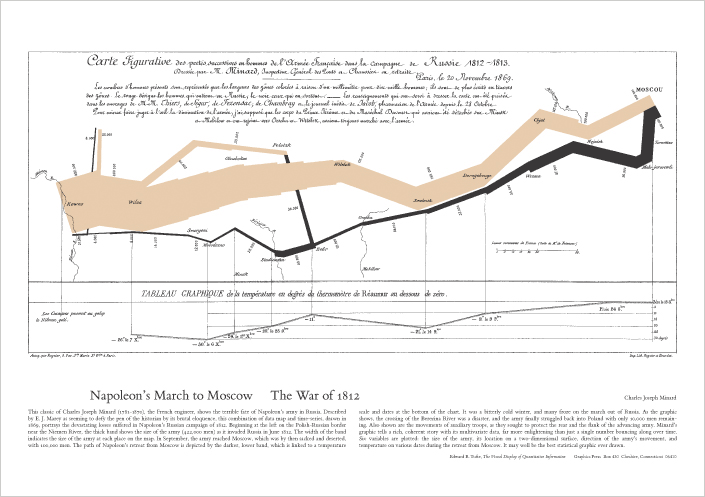
This is used to illustrate how including multiple types of information in a single graphic/visualization can be much more useful than what is usually done - narrowing down information until we have only one or two metrics shown.  Here the visualization helps the consumer distinguish the different instruments heard, the length of the notes, and value of the notes themselves (a low C from a middle C, for example).  This theme occurs again and again throughout the course - Tufte also uses the Minard Map as a good example of how to visualize multiple data points and metrics in a single place:


Edward Tufte has a reputation for disliking Powerpoint (OK, he did write an article on how it is 'evil'...).  He has a section on this in his course, but to me it seems his dislike is not so much for the tool itself as much as how it is used.  Specifically, he states that the problem is:
  • people often show too little data on slides (due to the limited space they provide)
  • many people simply re-read the bullet points when presenting, rather than supplementing them with additional information
  • powerpoint slides can be dictatorial/autocratic: the leader often reads the info to the audience, but the audience doesn’t have the notes/background material that went into creating the slides, only what is presented on them
Of great interest to me was the section of the course on mobile interfaces.  Most notably, Tufte has provided some criticism on both iPhone and Windows Phone 7.  He appears to like the former much more than the latter.

There are some really nice things about how Tufte presents the material in this course.  First, I like that he shows pictures and talks to/about them, rather than showing bullet points and reading from them.  The course ends up much more like a dialogue than like a lecture because of this.  Second, students are given all four of Tufte's books on data visualization, which is a great resource that helps continue attendees' education well after the course has ended.  Finally, Tufte uses all four books liberally throughout the day, so attendees get a good overview in the content contained in each; now when I have a question or point of interest I need to look up, I have a better idea of where to find the answer in his books, which has saved me a lot of time since.

Overall I would highly recommend this course.  The training on presenting data is very useful - I've implemented his recommendations and received positive feedback on several of the reports I wrote using it. The information on layouts and interfaces was also very helpful.  My one hope is that more technical people outside of user experience designers and researchers find the time to attend - engineers of all sorts, from developers and testers to Q/A engineers could all benefit.

Saturday, October 29, 2011

Grace Hopper 2011: What If I Could Attend Every Session I Was Interested In?

After several years of missing out, I'll finally be going back to the Grace Hopper Conference this November!  A combination of a more advantageous time with respect to my work and vacation schedule as well as my involvement with the Anita Borg Institute's Ambassador's program and recruitment efforts at work meant I could more easily fit it in this year.

It's always exciting to look at the schedule but with so many responsibilities to coordinate with sessions I want to attend, I find it useful to create a visual map of my schedule.  I did this for GHC 2008 and I've done it again this year, returning to Microsoft Visio to create it.  I have to say, I haven't found anything quite like the timeline feature in any other software and really like how easy it is to plug in my schedule using it!  I've converted mine to a graphic to share:


You can click to enlarge to a more readable size. :)

This year I'm particularly excited about a few of the mobile technology-related technical sessions, particularly the Thursday morning session on display security in mobile web browsers and HTML5 and mobile. What sessions are you planning to attend?  Which ones are you most excited about?  Am I the only one crazy enough to map out my schedule like this?